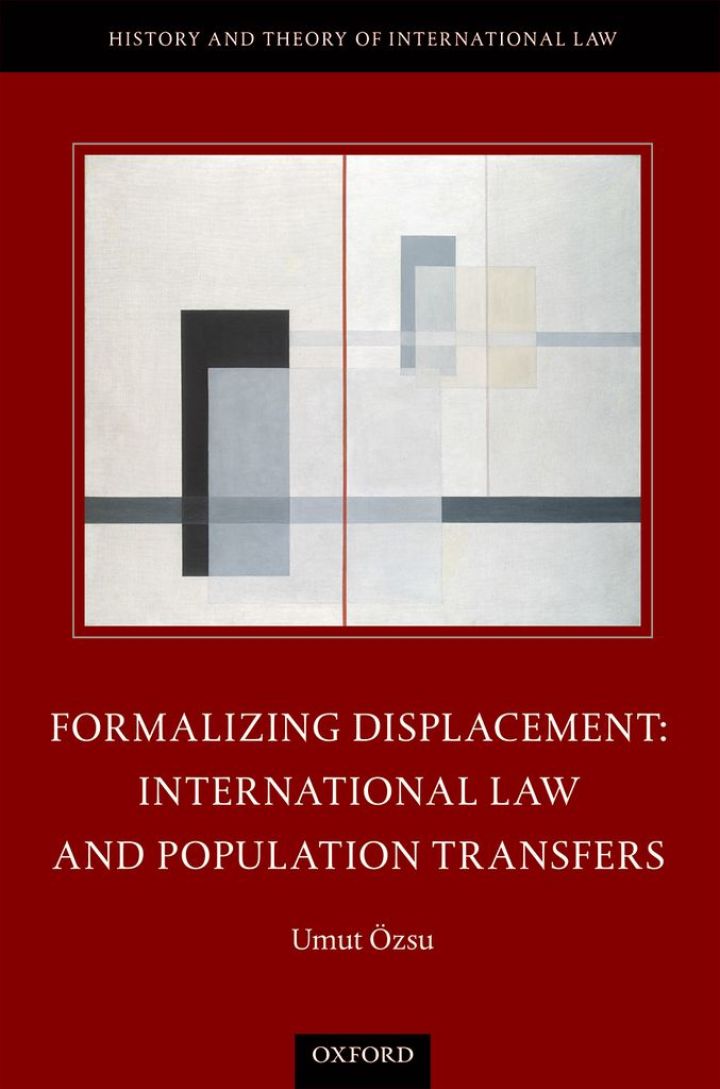
Formalizing Displacement International Law and Population Transfers
$45.50
Attention: This is just ebook, Access Codes or any other Supplements excluded! / File Delivery: Sent Via Email within 24 hours!

SKU: b9feadefcab6
Category: Law Textbooks
Description
-
Author(s)Umut Özsu
-
PublisherOUP Oxford
-
FormatPDF
-
Print ISBN
9780198717430, 0198717431 -
eText ISBN
9780198717430, 0198717431 -
Edition
-
Copyright
- Details
Large-scale population transfers are immensely disruptive. Interestingly, though, their legal status has shifted considerably over time. In this book, Umut Özsu situates population transfer within the broader history of international law by examining its emergence as a legally formalized mechanism of nation-building in the early twentieth century. The book’s principal focus is the 1922-34 compulsory exchange of minorities between Greece and Turkey, a crucially important endeavour whose legal dimensions remain under-scrutinized. Drawing upon historical sociology and economic history in addition to positive international law, the book interrogates received assumptions about international law’s history by exploring the ‘semi-peripheral’ context within which legally formalized population transfers came to arise. Supported by the League of Nations, the 1922-34 population exchange reconfigured the demographic composition of Greece and Turkey with the aim of stabilizing a region that was regarded neither as European nor as non-European. The scope and ambition of the undertaking was staggering: over one million were expelled from Turkey, and over a quarter of a million were expelled from Greece. The book begins by assessing minority protection’s development into an instrument of intra-European governance during the course of the nineteenth and early twentieth centuries. It then shows how population transfer emerged in the 1910s and 1920s as a radical alternative to minority protection in Anatolia and the Balkans, focusing in particular on the 1922-3 Conference of Lausanne, at which a peace settlement formalizing the compulsory Greek-Turkish exchange was concluded. Finally, it analyses the Permanent Court of International Justice’s 1925 advisory opinion in Exchange of Greek and Turkish Populations, contextualizing it in the wide-ranging debates concerning humanitarianism and internationalism that pervaded much of the exchange process.
Related products
-
Against Capital Punishment
Rated 0 out of 5$12.35 Add to cart -
Commercial Arbitration in Sweden 3rd Edition
Rated 0 out of 5$146.25 Add to cart -
Agency in Mental Disorder Philosophical Dimensions
Rated 0 out of 5$26.00 Add to cart -
BEYOND CONSTITUTIONALISM OCON C The Pluralist Structure of Postnational Law
Rated 0 out of 5$22.10 Add to cart