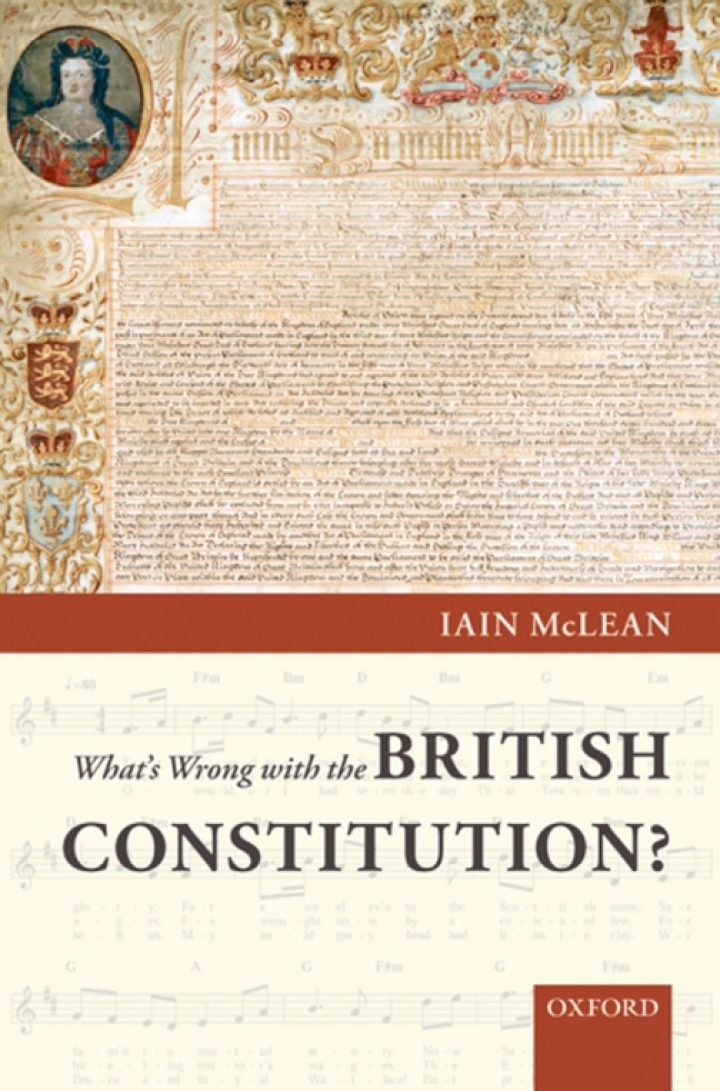
What’s Wrong with the British Constitution?
$22.10
Attention: This is just ebook, Access Codes or any other Supplements excluded! / File Delivery: Sent Via Email within 24 hours!
SKU: 17517568bce2
Category: Law Textbooks
Description
-
Author(s)Iain McLean
-
PublisherOUP Oxford
-
FormatPDF
-
Print ISBN
9780199546954, 0199546959 -
eText ISBN
9780199546954, 0199546959 -
Edition
-
Copyright
- Details
In this provocative new study, Iain McLean argues that the traditional story of the British constitution does not make sense. It purports to be both positive and normative: that is, to describe both how people actually behave and how they ought to behave. In fact, it fails to do either; it is not a correct description and it has no persuasive force. The book goes on to offer a reasoned alternative. The position that still dominates the field of constitutional law is that of parliamentary sovereignty (or supremacy). According to this view, the supreme lawgiver in the United Kingdom is Parliament. Some writers in this tradition go on to insist that Parliament in turn derives its authority from the people, because the people elect Parliament. An obvious problem with this view is that Parliament, to a lawyer, comprises three houses: monarch, Lords, and Commons. The people elect only one of those three houses. This book aims to show, contrary to the prevailing view, that the UK exists by virtue of a constitutional contract between two previously independent states. Professor McLean argues that the work of the influential constitutional theorist A.V. Dicey has little to offer those who really want to understand the nature of the constitution. Instead, greater understanding can be gleaned from considering the ‘veto plays’ and ‘credible threats’ available to politicians since 1707. He suggests that the idea that the people are sovereign dates back to the 17th century (maybe the 14th in Scotland), but has gone underground in English constitutional writing. He goes on to show that devolution and the UK’s relationship with the rest of Europe have taken the UK along a constitutionalist road since 1972, and perhaps since 1920. He concludes that no intellectually defensible case can be made for retaining an unelected house of Parliament, an unelected head of state, or an established church. The book will be essential reading for political scientists, constitutional lawyers, historians, and politicians alike.
Related products
-
Against Capital Punishment
Rated 0 out of 5$12.35 Add to cart -
A Theory of International Organization
Rated 0 out of 5$11.05 Add to cart -
Commercial Arbitration in Sweden 3rd Edition
Rated 0 out of 5$146.25 Add to cart -
Challenges for Humanitarian Intervention 1st Edition Ethical Demand and Political Reality
Rated 0 out of 5$27.62 Add to cart