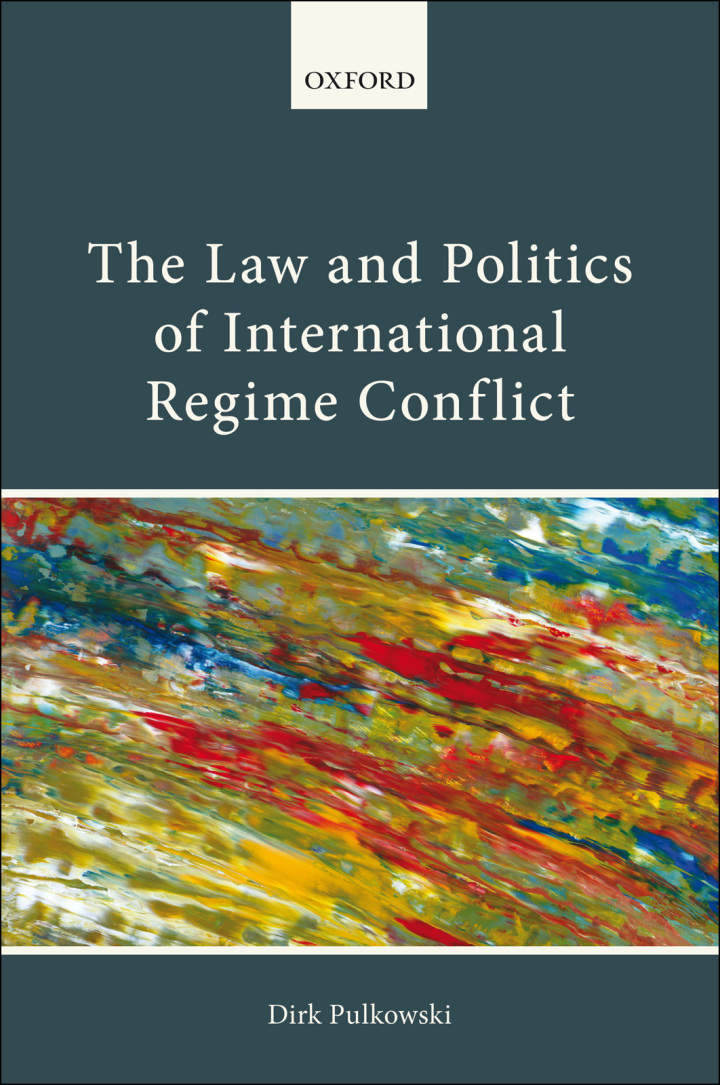
The Law and Politics of International Regime Conflict
$58.50
Attention: This is just ebook, Access Codes or any other Supplements excluded! / File Delivery: Sent Via Email within 24 hours!
SKU: 881f52412f15
Category: Law Textbooks
Description
-
Author(s)Dirk Pulkowski
-
PublisherOUP Oxford
-
FormatPDF
-
Print ISBN
9780199689330, 0199689334 -
eText ISBN
9780199689330, 0199689334 -
Edition
-
Copyright
- Details
The international order is constituted by a plurality of international regimes – institutionalized arrangements in different issue areas that possess their own norms and procedures. The present book examines how conflict among regimes may arise and probes the role that international law can play in managing such conflict. Throughout the book, the example of trade in cultural products is used to illustrate the evolution of regime conflict and the potential for its management. Conflicts between the goals of ‘free trade’ and ‘cultural diversity’ have notably surfaced within the World Trade Organization (WTO) and the United Nations Educational, Scientific and Cultural Organization (UNESCO). As a result, there is a potential for conflict among WTO law, the UNESCO’s Convention on the Protection and Promotion of the Diversity of Cultural Expressions, and human rights. The book posits that three dimensions are characteristic for regime conflict: First, regime conflict is a function of conflict among different social goals or values. Second, such goal conflicts are institutionalized through the interaction of a variety of political actors struggling for influence, often in intergovernmental organizations. Third, regime conflict may manifest itself in conflicts of legal rules. If a state acts in conformity with the rules of one regime, its conduct may trigger a violation of the rules of another regime. The author argues that, while international law cannot be construed as a fully integrated and unified system, it does provide a common language for different regimes to engage with each other. The shared discourse rules of international law enable a degree of coordination of the policies of different regimes, notably through techniques of interpretation and legal priority rules. International law contributes to the management of regime conflict by providing commonly accepted reasons for choosing among competing policy goals.
Related products
-
Challenging Acts of International Organizations Before National Courts 1st Edition
Rated 0 out of 5$43.88 Add to cart -
Agency in Mental Disorder Philosophical Dimensions
Rated 0 out of 5$26.00 Add to cart -
Blackstone’s Guide to the Proceeds of Crime Act 2002 5th Edition
Rated 0 out of 5$34.12 Add to cart -
Africa’s International Investment Law Regimes 1st Edition
Rated 0 out of 5$61.75 Add to cart